
PHOTO
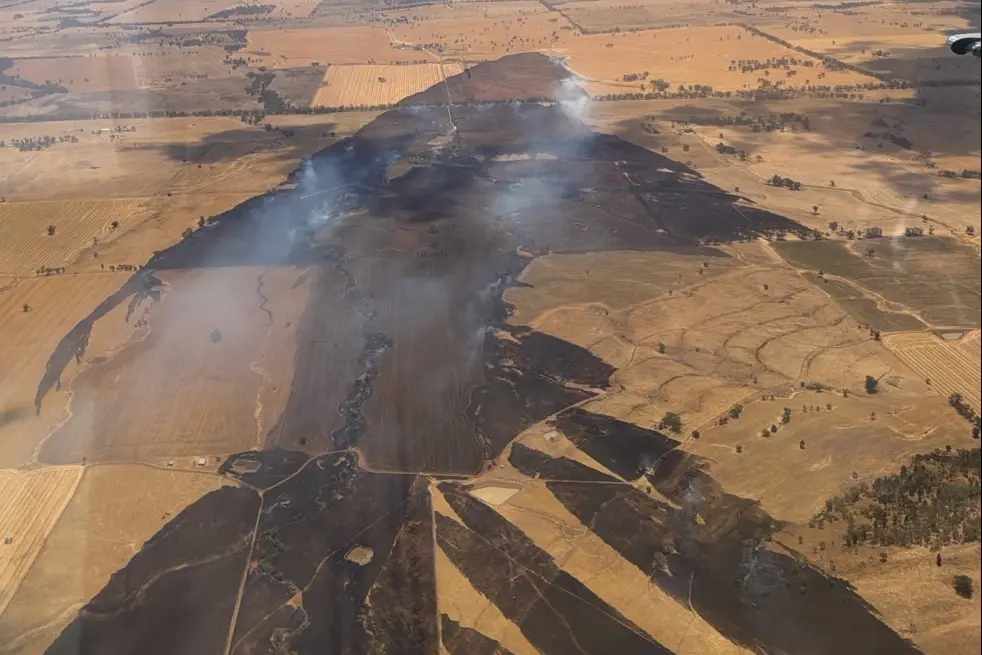
Firefighting efforts to stop a fast moving grass fire from entering the Hervey Ranges and Goobang National Park near Alectown have been described as miraculous.
Nearby farmers watched as dry lightning strikes in catastrophic fire conditions last Wednesday ignited the blaze between Alectown and Peak Hill on Kadina Road, about seven kilometres north of Alectown.
Wild weather lashed parts of the state last week and Parkes was among the areas hit hard.
The NSW Rural Fire Service detected more than 800,000 lightning strikes across the state over 24 hours last Wednesday, igniting several new fires including four in Parkes, two in Forbes and one in the Lachlan Shire.
The worst being the Kadina Road fire.
There was very little or no rain with it too, over what is a very dry landscape in the region at the moment.
Extremely strong winds were also recorded: Gusts peaked at 98km/h in Parkes at 11.02am that day, followed by 110km/h in Orange at 11.52am, 111km/h at Trangie at 12.01pm and 109km/h at Dubbo at 12.25pm.
"There was a multitude of lightning strikes in two bands that came through, one over Parkes and one south of Forbes," district manager for the RFS Mid Lachlan Valley team Michael Robinson said.
"We had eight incidents from the storm that came through - one was an MVA in the fireground and one was a large fire near Peak Hill and Alectown, on Kadina Road, even though there was rain with that."
Elevated fire danger forecasts saw the closure of several schools including Bogan Gate and Bedgerabong.
The Kadina fire affected landowners and quickly spread towards the Hervey Ranges and Goobang National Park.
It has seen a multiagency response, which included Parkes Council staff, National Parks and Wildlife Service (NPWS) and local farmers, to contain the blaze and bring it under control through the use of helicopters, water bombing and heavy machinery, and has since burnt 976 hectares.
"We had 30 fire trucks, multiple farmers and aircraft and heavy machinery from local council working hard on the fire," RFS Mid Lachlan Valley Team reported.
"Ground crew from RFS and NPWS, along with property owners, did an amazing job holding this fire with terrible conditions."
It was officially extinguished a week later, this morning.
Conditions were so terrible in Parkes last Wednesday that an RFS Chinook, one of the service's large firefighting helicopters, was based at Parkes for the day and was available for the Kadina Road fire.
Severe wind gusts hit at 11am, going from 43km/h to 80km/h to 98km/h in two minutes, according to the Bureau of Meteorology.
Winds did drop briefly afterwards but picked up again a few hours later, peaking at 69km/h.
Alectown farmer and Parkes Mayor Neil Westcott said the wild weather had been very destructive, bringing trees down and infrastructure damage to silos and blowing roofs off.
"The worst part were the dry lightning strikes," he said.
"Lightning struck, we looked up and the Kadina Road fire started," added Neil, who had been out helping to contain the fire.
"It's quite a miracle it didn't reach the Hervey Ranges and Goobang National Park.
"If it had, it would be burning for weeks."
Parkes Shire SES crews were called out to clear tree limbs off roads and assist with damaged buildings and roofs further north in the shire.
The Parkes SES unit in town received four call-outs all to roads to clear debris, the Henry Parkes Way to Orange and Renshaw McGirr Way.
"There was no property damage," Parkes SES deputy commander Kim Palmer said of the jobs her unit attended.
"We were very fortunate that we didn't have any serious property damage and our crews spent a few hours clearing roads and mopping-up trees and branches."
Peak Hill SES unit had infrastructure damage they attended.
Dangerous fire conditions continued in the shire over the days following.
While temperatures haven't been overly hot, it's the consistent strong winds that are causing headaches, particularly for farmers who are right in the middle of harvest.
Farmers and the Forbes Fire Control Centre are having to monitor operations and conditions very closely, and the grain storage bunkers at the Parkes Silos have even had to shut a few times this harvest because of strong winds.
The highest temperature only reached 34 degrees when the conditions were at their worst last week and 10mm of rain was recorded out at the Parkes Airport over a 20 minute period from 11am.
The dry conditions have been ideal for harvesting but it brings a heightened fire risk.
"With machinery operating it increases the potential of a fire," Mr Robinson said.
"All it takes is a mechanical issue to start a fire - between that and motor vehicle accidents and hot exhausts too."
Neil said they've had a very dry spring with crops coming in early.
"Which has been great for getting crops off," he said.
"But when [the Kadina fire] did ignite it moved very quickly. We were very lucky to have the Chinook helicopter here.
"We had good eyes in the sky and with the water bombing it gave us a chance to catch it.
"It was very cold at the start of harvest but now it feels like summer.
"Farmers still have a few weeks left of harvest... I've just finished... But it's early to be finishing in November."