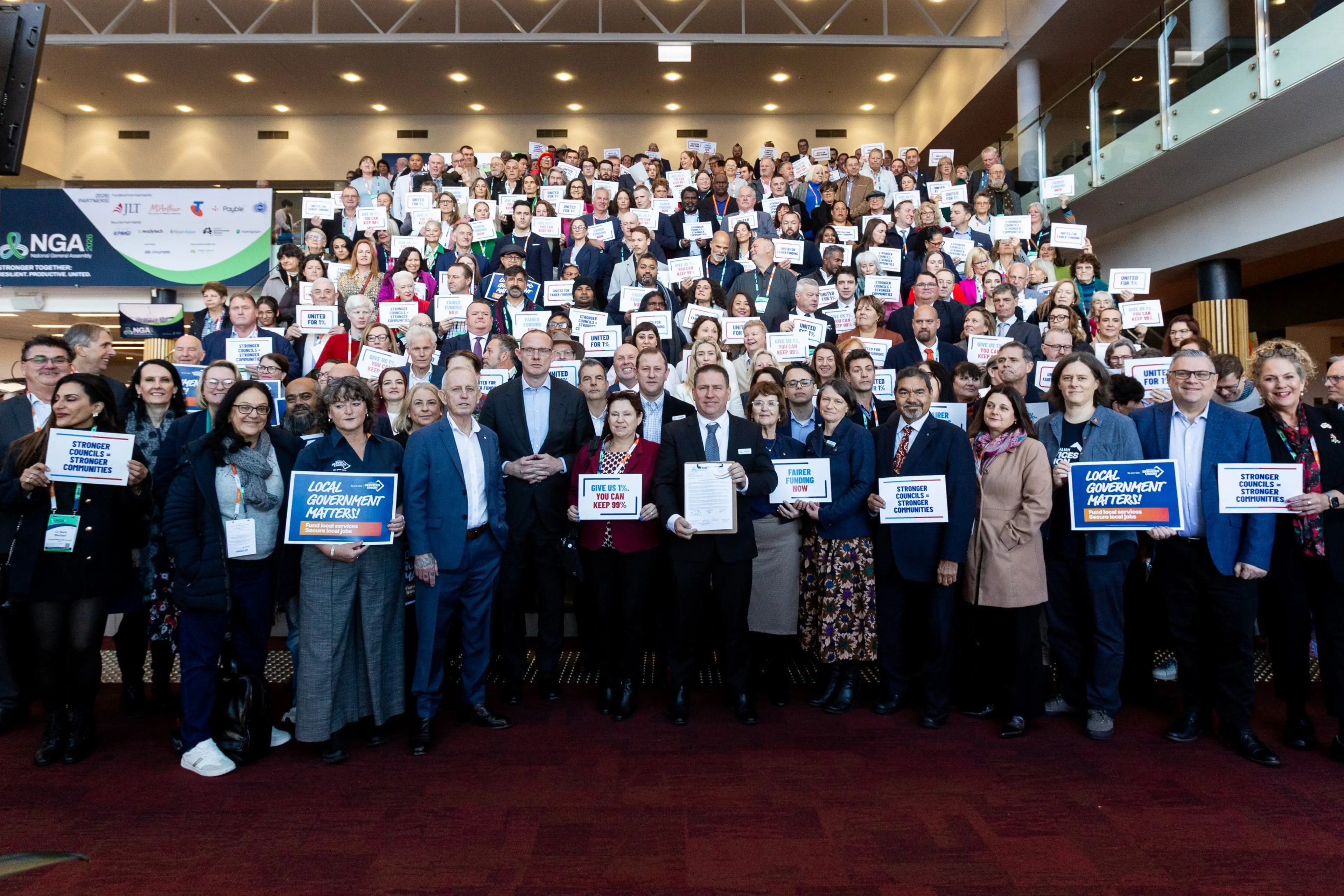
Councils from every state and territory have joined forces with unions representing the local government sector to warn Federal Parliament of a looming financial crisis.

A letter, signed by associations representing more than 500 councils nationwide, was endorsed at the National General Assembly of Local Government.

The letter will be sent to the Speaker of the Parliament as well as every MP and Senator in a move President of Local Government NSW Mayor Darcy Byrne said was unprecedented.

"Today mayors from every corner of the continent are joining with unions representing the whole Local Government workforce to say this crisis in funding for councils must be addressed," Cr Byrne said.

"In many regional communities in particular there is simply not enough funding for basic services to be maintained. That's why we have taken this unprecedented step to force the Parliament to act on this crisis."

This joint call to increase Commonwealth Financial Assistance Grants comes as a growing number of regional councils in particular face severe financial pressures that threaten basic services.

"Councils provide vital services and infrastructure that our national economy and productivity rely upon," the letter says.

"The success of our Australian system of government depends upon our councils succeeding at grassroots level.

"But this system is in jeopardy.

"Long term planning and delivery requires long term financial security and certainty.

"Councils have limited options to raise revenue and in many cases are highly reliant on untied financial assistance grants from the Commonwealth."

Parkes Shire Council's general manager Kent Boyd, Mayor Neil Westcott and Cr Bill Jayet joined hundreds of councils at the National General Assembly last week. PHOTO: ALGA

At Budget time this year, Parkes Shire Council flagged the importance of maintaining a very high level and discipline approach for expenditure over the next 12 months, pointing to an $8.81 million deficit.

This is largely attributable to non-cash asset depreciation expenses that rose more than $7 million in the last financial year.

Parkes' budget report outlined that the financial challenges are not unique to this council but "reflect a widespread and deepening structural issue across local government in NSW and nationally".

"The sector is facing sustained operating deficits, escalating asset renewal backlogs and declining real revenue," it said.

Almost 80 per cent of Parkes' capital works program of $90.94 million is also reliant on government grants and contributions, but there's since been a withdrawal of a number of once-recurring state and Commonwealth grant programs.

Council has backed campaigns for local government to receive one per cent of Commonwealth tax revenue, joining the Country Mayors "invest in us" call just two months ago.

As has Forbes Shire Council.

Forbes Mayor Phyllis Miller said the past several years has seen unprecedented operational cost increases with successive Australian Governments rolling back Financial Assistance Grants to close to half (0.51%) of the one per cent they started at.

"There are other federal funding programs accessed by rural, remote and regional councils in NSW, but they are project-based and do not help to keep the lights on," she said.

*Copy_Councils call for fairer funding_Image002_71624
Forbes Mayor Phyllis Miller OAM at the conference.

Federal Assistance Grants have fallen from one per cent of Commonwealth taxation revenue to barely half that over 30 years, United Services Union general secretary Graeme Kelly said.

"That decline has real consequences for the workers and communities who depend on council services," Mr Kelly said.

"Restoring the one per cent benchmark is the single most important thing Canberra can do for local government."

In NSW there are more than 50,000 council workers and National Secretary of the Australian Services Union, Emeline Gaske, highlighted the impact the crisis will have on the workforce.

“Council workers keep Australian communities running every single day,” Ms Gaske said.

“They collect our bins, run our libraries, maintain our roads and support communities through floods and fires.

"They do this work professionally and with commitment, but they need councils that are properly resourced to back them up.”

CHAFFEY BACKS COUNCILS

Federal Member for Parkes Jamie Chaffey, a former mayor of Gunnedah shire, has thrown his support behind councils in their call for funding.

In parliament, Mr Chaffey called on the House to recognise that local councils plan for residential and industrial growth in communities; build and maintain tens of thousands of kilometres of roads; provide sewer, water and waste services; manage parks, gardens, sporting fields as well as libraries, halls, galleries and civic centres.

He condemned the federal government for cutting funding to local government.

"As human beings, some of our most basic needs are clean water, reliable sanitation and shelter," Mr Chaffey said in parliament. "These are mostly the domain of local government.

"We have a need for human connection that relies on local roads to bring us together. This is also the responsibility of local government.

"Take a look at the parks where we played as children and have spent time with family and achieved our sporting goals. Again, this is the work of local government.

"And who maintains the footpaths, ensures pets are part of our community and guides the planning and development of the towns and cities in which we live? Local government - the very same organisations that ensure there are cemeteries where our loved ones can visit us once we have gone.

"Which tier of government has been systematically underfunded and ignored in the recent budget?

"Which tier of government is collapsing under the weight of cost shifting and price increases? And which tier of government has no grant fund available to plan for communities' futures? The answer, again, is local government."

In a letter to Forbes Shire Council, Mr Chaffey said he was working with Senator Bridge McKenzie to develop a policy framework to deliver fair and sustainable outcomes for local governments.