PHOTO
CENTRAL WEST ASTRONOMICAL SOCIETY
A fortnight ago, in the early evening of 21 May, many people across the Central West of NSW, as well as a wide area of eastern Australia generally, saw a spectacular fireball light up the sky as a meteor streaked through the Earth’s atmosphere.
Also known as a bolide, the momentary light show was much brighter than a typical “shooting star”.
It is surprising how small a piece of rock can be to create such a brilliant explosion of light.
The rock that produced this fireball was probably 30 to 50 centimetres in diameter (about the size of a basketball).
After a journey of possibly hundreds or even millions of years, which possibly took it around our Sun countless times, it eventually collided with our atmosphere.
Travelling at a tremendous speed, the heat that it generated as it moved through our atmosphere caused it to glow and ultimately explode into much smaller pieces.
Although most of the rock burned up in the atmosphere, it is possible that a small piece made it all the way to the ground as a meteorite.
However, the remaining meteorite was likely too small to cause any serious damage.
(The meteor that is believed to have wiped out the dinosaurs 65-million-year ago is estimated to have been around five kilometres wide.)
I recall driving through Liverpool in Sydney back in the early 1990s.
I was stopped at traffic lights at 3pm, in broad daylight, when I saw a brilliant bolide streak across the sky.
I can only imagine how brilliant it would have been if it happened to be at night time when I saw it.
The material that causes more modest streaks across the sky, sometimes inaccurately called “shooting stars” tends to be even smaller; often no larger than grains of sand.
These small meteors can appear randomly as individual streaks at any time of the night.
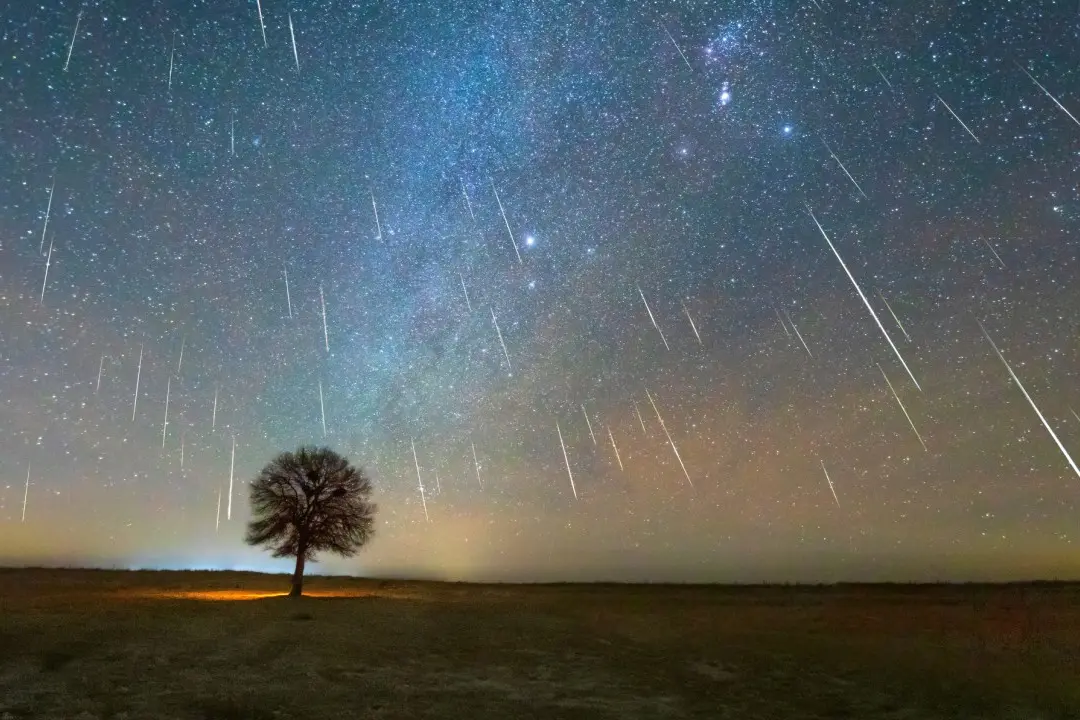
However, on certain nights each year, meteors can be seen streaking through the sky often many times per minute.
These meteor showers take their name from the star or the constellation that the meteors seem to be streaking from.


A month ago, on the evening of 5 May, the Eta Aquarid meteor shower reached a peak of 35 meteor streaks per hour (around one streak every two minutes, all appearing to travel away from the star Eta Aquarii in the constellation Aquarius).
Meteor showers can be observed on the same days each year, year after year, unless they happen to coincide with a full moon that brightens the sky too much to see the streaks clearly.
The reason we are able to see meteor showers so predictably is interesting.
Imagine a motorist taking a load of rubbish to the tip in their trailer, but forgetting to cover their load with a tarpaulin; something that I would not recommend doing as the police rightly take a dim view of.
The motorist leaves behind a trail of rubbish all the way to the tip.
Similarly, as comets orbit around the Sun, they leave behind a trail of debris.
On particular days of the year the Earth happens to pass through these cometary debris trails, and the debris burning up in our atmosphere results in these meteor showers on certain days of the year.
However, there is one problem with viewing meteor showers at a reasonable time of the night.
As it happens, as the Earth rotates on its axis once a day, it is during the hours between midnight and dawn that when we look into the sky we are looking in the direction in which the Earth is moving as it orbits the Sun.
This unfortunately means that the best time to see a meteor shower is in the hours before sunrise.
(This is sometimes called the Windscreen Effect and is the reason insects only ever get splattered on your car’s windscreen; never on the rear window.)
It you missed the Eta Aquarids, the next meteor shower will be the Delta Aquarids on the nights of 28 July and 29 July.
Another interesting fact about the Eta Aquarid and Delta Aquarid meteor showers is that they are caused by the Earth passing through the debris trail of the famous Halley’s Comet.
If you would like to learn more about bolides, meteor showers and anything else about our amazing night skies, you are most welcome to come along to the next meeting of the Central West Astronomical Society (CWAS), tomorrow night, Friday 5 June, upstairs in the Sunset Room of the Parkes Services Club in Short Street.
The meeting starts at 7.30pm.
Members of the public are always welcome and admission is free.