PHOTO
CENTRAL WEST ASTRONOMICAL SOCIETY
Readers may possibly recognise part of the statement above as a quote from Arthur C Clarke’s iconic science fiction book and movie, 2001: A Space Odyssey.
This month I am discussing galaxies, which are indeed “full of stars”.
People generally understand galaxies as immense “cities” of billions of stars, all held together by their common gravitational forces.
However, perhaps less well-known is that there are three main types of galaxies: Spiral Galaxies, Barred Galaxies and Irregular Galaxies.
Each has a generally distinctive structure depending on their overall rotation and how the gravitational forces of their individual stars act on each other.
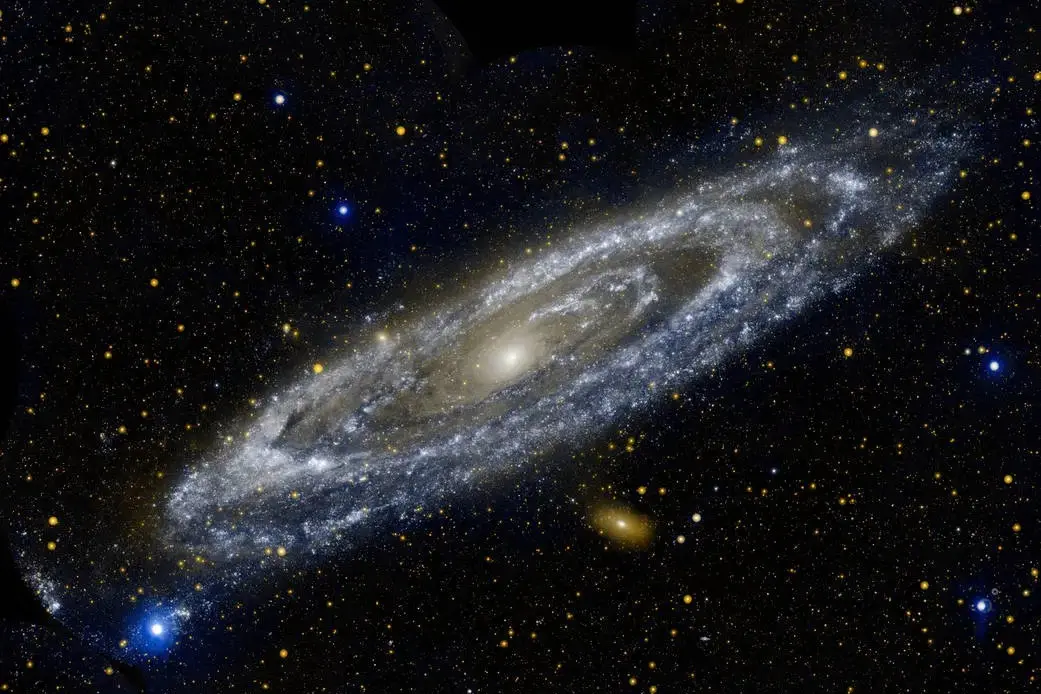
Spiral galaxies such as our own Milky Way and our neighbouring Andromeda Galaxy have classic spiral structures, created by the rotation of the galaxy and the gravitational forces at work within the galaxy.
Interestingly, because we are inside our own Milky Way Galaxy, we cannot take a photo of it from the outside, as it would take thousands of years to fly up above the Milky Way to then look down at it.


So how do we know that the Milky Way is a spiral galaxy?
Our very own CSIRO Parkes Radio Telescope has been able to “look” through the Milky Way as it appears in the night sky, to observe its underlying structure.
Barred galaxies, such as NGC 1300, have a bright “bar” of stars across their centres.
“Arms” of stars spiral out from each end of the central bar.
Irregular galaxies cannot be easily grouped into the other categories due to their indistinctive structures.
Examples of irregular galaxies are our neighbouring Large Magellanic Cloud and Small Magellanic Cloud in the southern sky, as well as the two Antennae Galaxies, in the equatorial sky, slowly “melting” together as they collide with each other.


If you would like to learn more about galaxies and other amazing features in the night sky, you are welcome to come along to the next meeting of the Central West Astronomical Society (CWAS), tomorrow evening, Friday 4 September, commencing 7.30pm in the Sunset Room upstairs in the Parkes Services Club in Short Street.
The CWAS meets on the first Friday of each month (except January), and meetings are free and open to the public.